

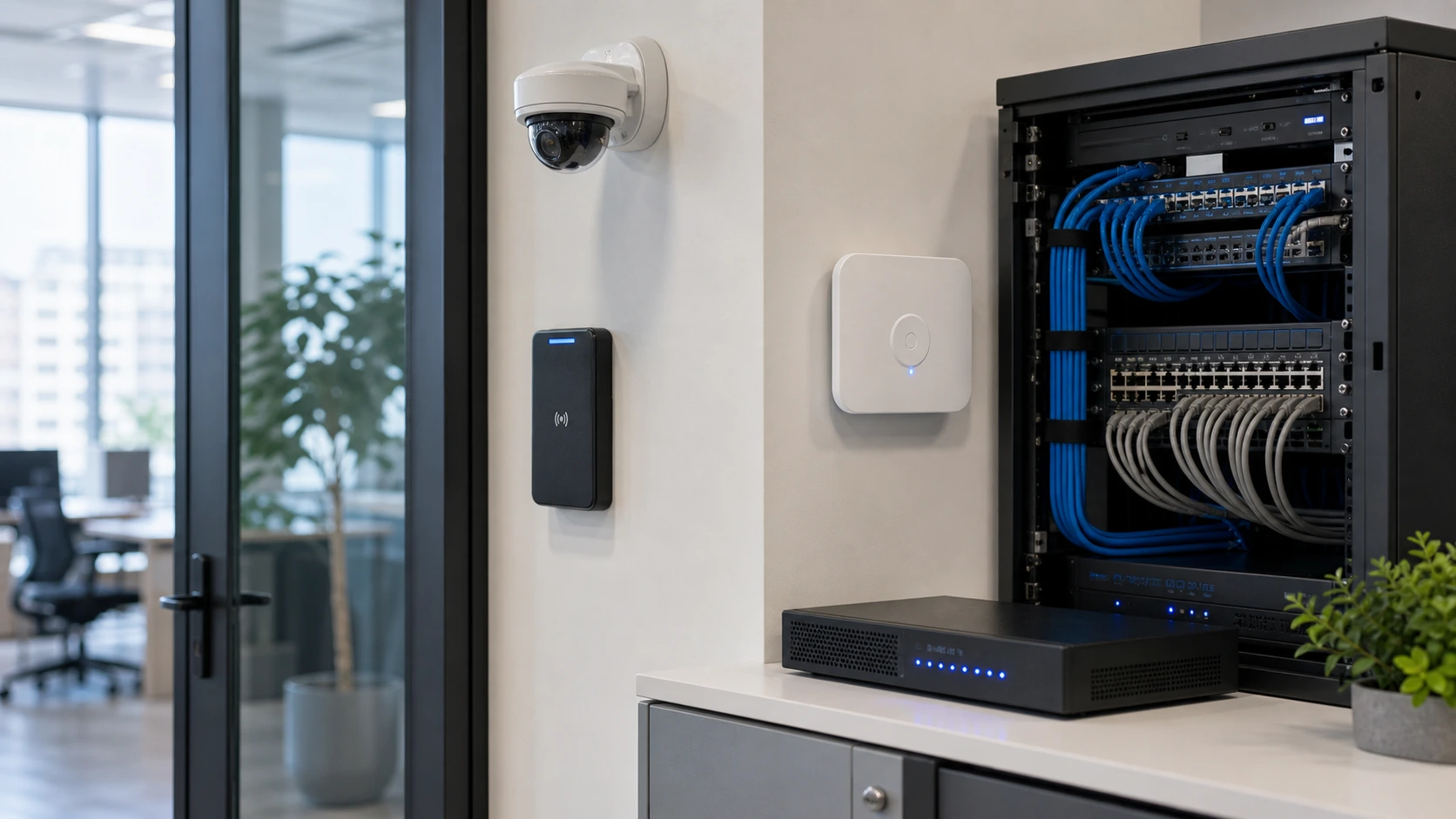
Network, security and access control for a modern office
A modern office is much more than a beautifully designed space. For the team in the building, the real difference is felt in the stability of the network. The speed of connection to applications and the security of access are essential. The way equipment is managed directly influences daily productivity. When these technical details are left to the end, numerous improvisations appear. Cables end up being unsightly pulled next to the furniture. Wi-Fi passwords are distributed randomly and completely insecure. Cameras do not register correctly, and doors open without clear rules.
The network must be designed by area, not just installed
The first question is not limited to the router model you buy. You need to know from the start which areas need to be served. A company usually has open offices, meeting rooms and a reception. There are spaces for visitors, printing, storage and security equipment. Sometimes perfectly soundproof technical rooms are also needed. Employee laptops need to be able to quickly access internal and cloud applications. Guests at the office must be given completely separate access. Video cameras need to be isolated, and critical equipment needs to be protected from unnecessary traffic.
A well-designed network uses only managed switches and secure VLANs. Clear access policies and properly managed passwords always make a difference. The Wi-Fi network requires carefully measured coverage in advance. This is not an investment intended exclusively for huge corporations. Even a small company needs stability and constant speed. Accounting data and business documents must be kept completely safe. Access to applications should not depend on a simple home router.
Technical documentation reduces intervention time
In a new office, written documentation is vital. There should always be a clear diagram of all network ports. Equipment locations and firewall settings require accurate and up-to-date documentation. Administrative passwords should be kept exclusively in a perfectly secure manager. An accurate record of IP addresses and connected devices is required. When a problem occurs, the IT technician must intervene quickly. He should not waste valuable time searching for cables in offices.
Buildings that take the technical side seriously simplify all this work massively. Many companies are looking for a office building with documented technical infrastructure from the beginning. Here it is worth checking in advance the spaces dedicated to completely sensitive equipment. The power supply and the wiring routes must be carefully analyzed and measured. The expansion of the network must remain possible without very expensive wall interventions.
Firewall, access policies and endpoint protection
Cybersecurity in a modern office starts at the edge of the network. However, advanced protection should not stop there. The firewall should be configured with clear rules, up-to-date updates and useful logs. Administrative access from the outside remains strictly and heavily restricted. Guest networks should never communicate with internal company resources. CCTV equipment should be quickly hidden from direct access to the public internet. Remote connections require strict security via VPN and multi-factor authentication.
At the workstation level, each laptop requires dedicated endpoint protection. Encryption of sensitive data is absolutely mandatory where required by law. User accounts must have limited privileges and clear update policies. Many incidents do not start from very sophisticated or massive cyber attacks at all. They often arise from weak passwords or completely outdated hardware. The lack of a clear procedure for when an employee leaves is another major risk.
Always include onboarding and offboarding scenarios in your office design. The arrival of a new colleague requires a clear path to configure the laptop. Wi-Fi access and rights in company applications must be allocated extremely quickly. Also, the building entrance card requires immediate registration. When a person leaves, the exact same accesses must be withdrawn quickly and verifiably. These clear processes reduce risks more than a thousand isolated technical settings.
CCTV and access control: security without operational chaos
CCTV and access control systems are constantly adapting to the flow of employees. We need to clearly establish who enters the building first in the morning. It is also necessary to define exactly who accesses the central technical room. The way visitors are welcomed inside is another sensitive point. The answers must be firmly established before any hardware installation begins. They directly influence the positioning of the cameras and the choice of the type of readers mounted in the doors.
Many companies are looking for a administrative headquarters in the center for frequent business meetings. These areas with intense pedestrian traffic need clear rules for visitors. Reception and access to the building after the end of the program must be managed very rigorously. Modern technology helps business only if it is perfectly complemented by extremely simple and well-known procedures.
Maintenance makes a difference after installation
An excellent technical infrastructure is not a project completed on the day of inauguration. The network must be constantly monitored for bottlenecks, and the equipment requires security updates. Data backups are checked daily, and error logs remain carefully analyzed. As the company grows, the overall network configurations must be immediately adapted. Without periodic IT maintenance, even a very correct installation ages far too quickly.
A minimum plan includes periodic technical reviews of firewalls and switches. Access points and security cameras require truly constant logical inspections. Testing corporate UPSs and auditing active accounts remain just as important. Restoration simulations provide the company with maximum security against any unforeseen disaster. All these mandatory checks must not be treated as mere boring formalities.
They are the ideal way for your company to avoid daily interruptions. Information and file losses are prevented through organization and a lot of attention. Nobody wants dangerous situations with completely unknown or lost access permissions. It is worth establishing a clear weekly change log in the IT department.
Any important password or firewall rule change should be written down. Moving a network port or issuing a new card deserves to be noted somewhere. There is no need for excessive or overly complicated corporate bureaucracy. Minimal technical evidence allows the entire team to instantly understand recent changes. Technical network issues are resolved much faster in this documented way. The modern office remains, ultimately, a complete ecosystem in which people, equipment and procedures work together for the success of the business.

Leave a reply