

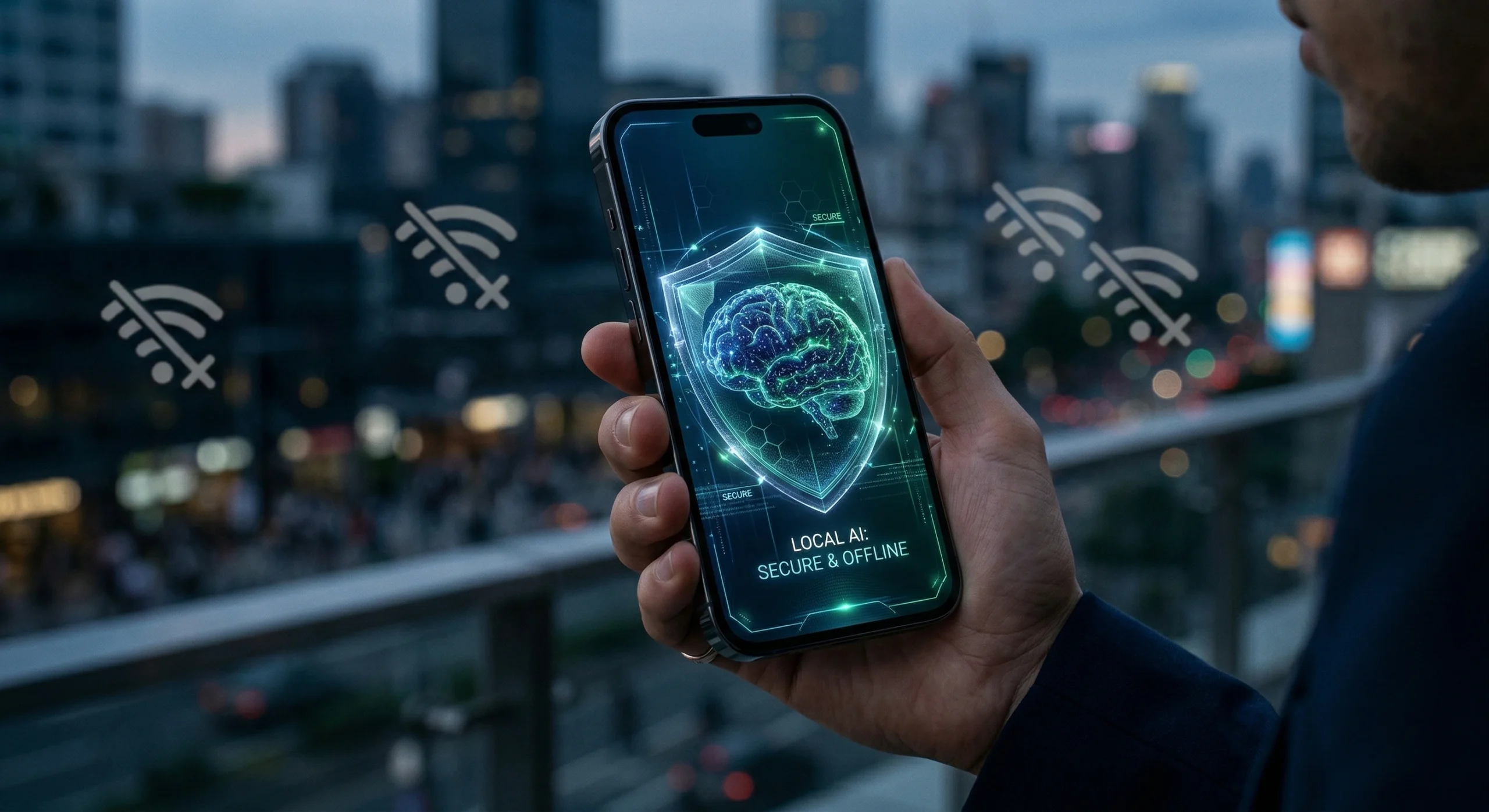
AI on your device: Why the next AI assistant won't need the internet anymore
Until now, to use a powerful AI model you needed an internet connection. Everything happened on huge servers, somewhere far away, and you received the answer over the network. In 2026, this dependency begins to disappear. Small and efficient AI models can run directly on your phone or laptop, without sending a single byte of data to an external server. At Altanet Craiova We believe this change is one of the most important for the confidentiality of personal and business data.
What does on-device AI mean?
The technical term is Edge AI – artificial intelligence that works „at the edge,” meaning directly on the user’s device, not in the cloud. The concept is not new, but in 2026 it made the leap from experiment to real commercial product.
Think about the difference between two scenarios:
- AI in the cloud: you type a question on your phone, it goes to a server in the US or Europe, the model processes it, the answer comes back to you. Your data has traveled back and forth across the internet.
- AI on device: everything happens directly on your phone. The question never leaves your device. You don't need the internet. The answer comes in fractions of a second.
What concrete advantages does it bring?
There are four main benefits for which companies and individual users will choose on-device AI in 2026:
- Total confidentiality: data never leaves the device. Ideal for medical information, contracts, financial data or any other sensitive content.
- Operation without internet: The model also works on airplanes, in areas without signal or on networks with restricted access.
- Zero latency: There is no network lag. The response is instantaneous, which makes the experience much smoother.
- Zero cost per use: you don't pay per query, as happens with cloud models. The model is installed once and works indefinitely.
How widespread is on-device AI in 2026?
The graph below shows the level of AI implementation on the device by product category:
Mature implementation
Growing
Who are the main players?
Several companies took important steps in this direction in 2026:
- Apple: M and A series processors include dedicated units for local AI, and Siri has switched to a language model that runs entirely on the device for basic interactions.
- Qualcomm: Snapdragon processors for Android smartphones now include NPUs – that is, specialized AI processors – powerful enough to run average language models.
- IBM: IBM's Kaoutar El Maghraoui confirms the direction: „Edge AI is moving from hype to reality.”
- OpenClaw: one of the first persistent personal agents that runs locally, connected to the user's files and applications, without the data leaving the computer.
What are the limits?
On-device AI is not completely replacing the cloud – at least not yet. Models running locally are smaller and less capable than large cloud-based ones. For complex tasks – analyzing a long document, generating images, deep reasoning – the cloud remains superior. The solution adopted by most companies is the hybrid one: simple and sensitive tasks are solved locally, complex tasks are sent to the cloud.
What's next?
Estimates show that by 2027, every high-end smartphone will include a local AI assistant capable of complex reasoning. Ambient AI – always present on our devices, acting without being explicitly invoked – is becoming the norm. By 2028, 75% of enterprise AI will run on hybrid infrastructures, combining local and cloud processing.
If your company manages sensitive data and you want to understand how you can use AI without exposing that data to external servers, the team Altanet Craiova can help you with a concrete evaluation. Visit our website contact and let's discuss.
This article is part of Altanet's series on AI trends in 2026. Next article: AI Video in 2026: From Idea to Marketing Clip in Minutes. See also the complete guide to the series.

Leave a reply