

AI Physics and Robotics: When humanoid robots start their first factory job
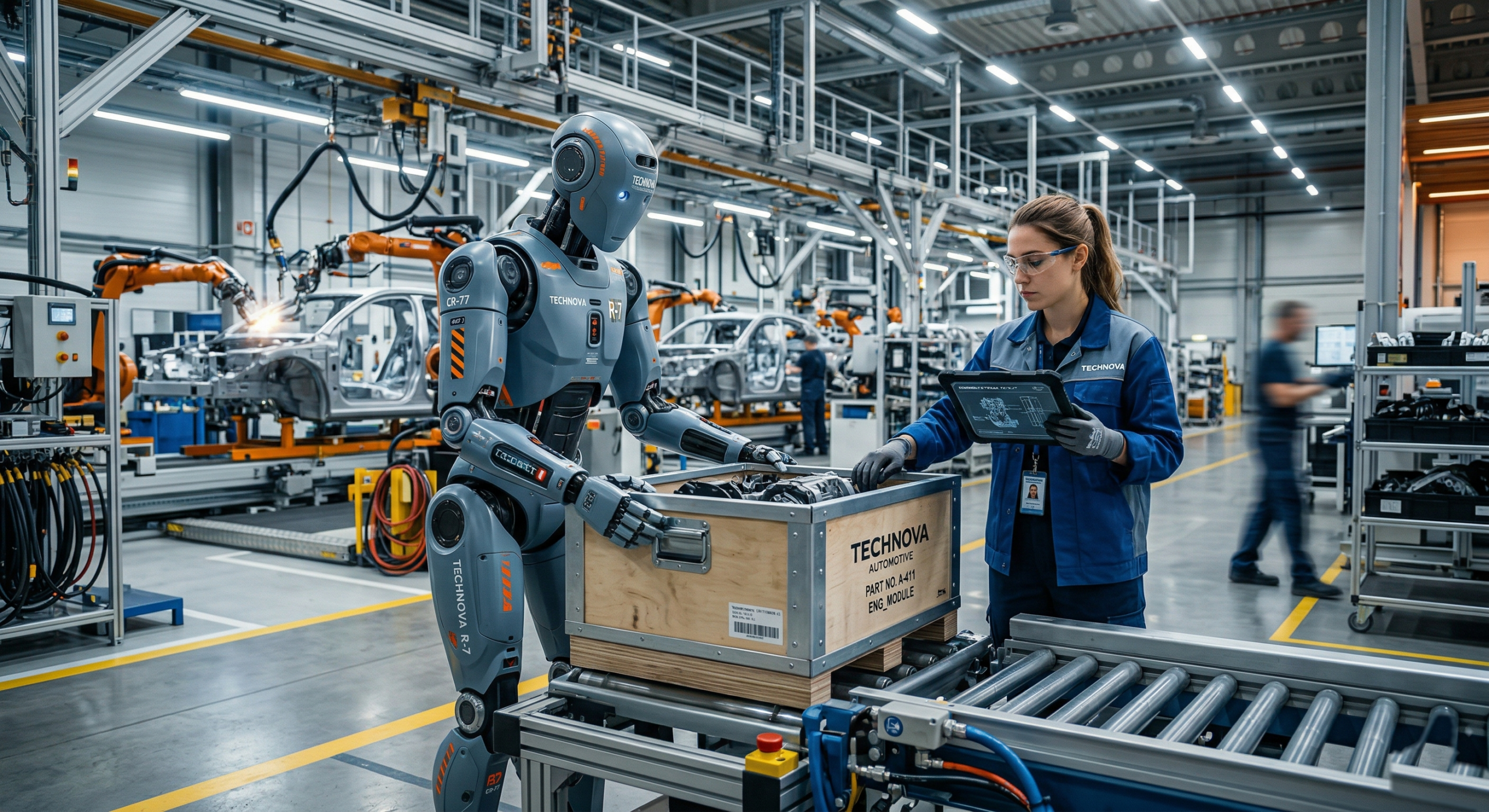
For years, humanoid robots existed only in science fiction movies or spectacular demonstrations on conference stages. In 2026, they took the next step: they left the laboratory and entered real factories, where they work alongside humans. At Altanet Craiova We believe this is one of the most spectacular changes that AI is bringing to the physical world – and it's just getting started.
What is physical AI?
Until now, AI lived exclusively in the digital world: answering questions, generating texts, analyzing data. Physical AI is the next step – artificial intelligence systems that perceive the real world through cameras and sensors, make decisions and act through mechanical arms, wheels or legs.
Company Deloitte describes this change simply: „AI is becoming physical.” We are no longer talking about a program on a server, but about a system that lifts a box, screws a part, or pushes a cart in a warehouse.
Atlas' first real job
In January 2026, the robot Atlas produced by Boston Dynamics began its first field test in a real factory – the plant Hyundai from Savannah, Georgia. This moment was transmitted by CBS on the show "60 Minutes"„ and attracted the attention of the whole world.
Why is it important? Because Atlas is not a fixed mechanical arm, mounted on an assembly line. It is a robot that walks on two legs, climbs stairs, picks up objects of different shapes and adapts to unstructured spaces – just like a human worker.
What other companies are in the race?
Boston Dynamics is not alone. In 2026, several major companies have introduced or tested humanoid robots in industrial environments:
- NVIDIA Alpamayo: a 10 billion parameter AI model specifically created for robotics and autonomous driving, capable of understanding the physical environment and making decisions in real time.
- Figure AI, Agility Robotics, Apptronic: American startups that are already delivering humanoid robots to warehouses Amazon, factories BMW and other large companies.
- Unitree, Fourier Intelligence: Chinese manufacturers offering humanoid robots at significantly lower prices than Western competitors.
to CES 2026, the Las Vegas technology expo, humanoid robot demonstrations dominated the media. They are no longer curiosities – they are commercial products.
Where are they used now and where will they be soon?
The chart below shows the main application areas of AI robotics in 2026 and implementation estimates:
8%
Mature commercial implementation
Growing / pilot
Why now and not earlier?
Classic industrial robots have been around for decades. What changed in 2026 is the convergence of three technologies that matured at the same time:
- Perception: Cameras and sensors are now good and cheap enough for a robot to "see" and understand the space around it in real time.
- Simulation: Before being sent to a real factory, a robot can be trained for millions of hours in a virtual environment. NVIDIA has created platforms dedicated to this type of training.
- AI models: The brains that coordinate everything are now capable enough to make good decisions in unexpected situations, not just in pre-established scenarios.
What's next?
IBM Research is direct in his estimates: „Robotics and physical AI will definitely accelerate.” Estimates show that by 2028, AI robots will be standard equipment in logistics and factories. Home applications are still limited, but in the industrial environment the ROI (i.e. the money recovered from the investment) is already measurable.
For Romania, this trend is especially relevant in the automotive industry and logistics, two sectors in which our country has a significant presence. Companies that start to familiarize themselves with these technologies now will have a clear advantage over those that have not taken the step.
Do you want to know how AI robotics can affect the sector you work in? The team Altanet Craiova Follow these developments and it can help you understand what they mean specifically for your business. Visit our website contact and let's discuss.
This article is part of Altanet's series on AI trends in 2026. Next article: AI in Health: How an algorithm detects disease earlier than the doctor. See also the complete guide to the series.

Leave a reply