
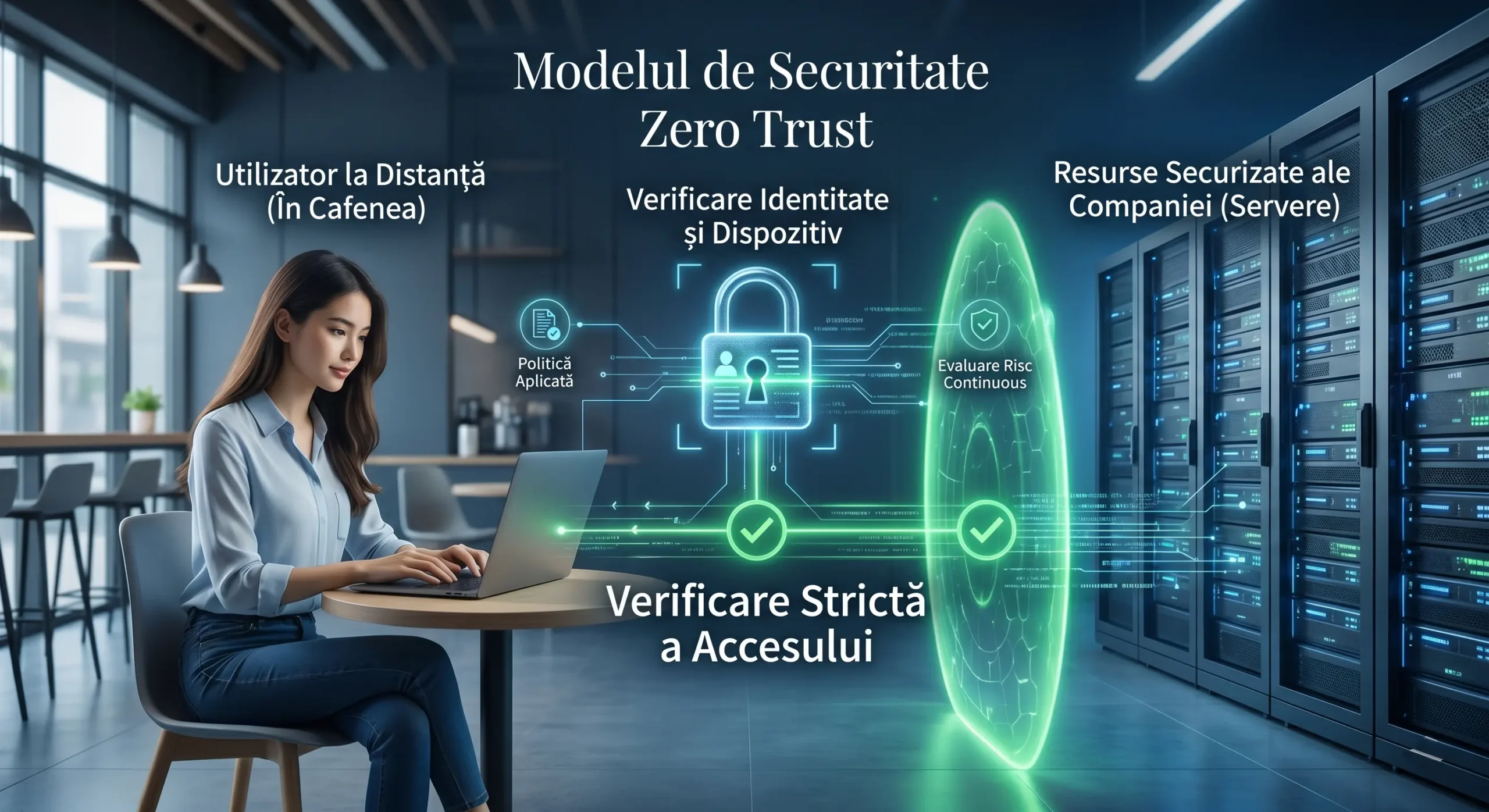
In 2026, working from home has become the norm for many companies. Employees access sensitive data from outside the office. This freedom, however, also brings enormous security risks. At Altanet Craiova particular emphasis is placed on modern protection models. One of the most secure concepts today is Zero Trust architecture. This system completely changes the way access to information is controlled. In the past, the physical perimeter of the office kept equipment safe. Today, the company network extends wherever a work laptop is located. Corporate security must be urgently adapted to this reality.
The traditional model used VPN networks exclusively to connect people. Once connected, an employee had freedom across almost the entire network. If their password was stolen by hackers, they compromised the whole company. Zero Trust architecture completely eliminates this major vulnerability. The system gives no automatic trust to any user or device on the network. Every login attempt is verified constantly and repeatedly. The corporate network thus becomes an impenetrable, well-controlled structure.
1. The basic principle: trust no one, verify everything
The concept is based on a simple but extremely strict technical rule. No one is considered safe by default, not even internal employees. The cybersecurity experts at Okta strongly support this modern direction. Every device requesting access must prove it is legitimate. Smart platforms check both the identity and the state of the laptop being used. If a computer does not have its antivirus up to date, access is rejected automatically.
Multi-factor authentication (MFA) becomes absolutely mandatory here. Entering a simple password is no longer enough in 2026. The user always confirms the login through an app installed on their mobile phone. In addition, permissions are granted strictly for the application needed for their work. A sales employee will not be able to access the accounting department's files. This smart separation reliably blocks the spread of viruses inside the company.
| Technical characteristic | Traditional model (castle/VPN type) | Zero Trust architecture |
|---|---|---|
| Level of trust | Implicit trust in the local network | Zero trust for everyone |
| Application access | Wide open after the first login | Micro-segmented and strictly limited |
| Device verification | Weak or non-existent initial check | Permanent health monitoring |
2. The benefits for distributed teams and data protection
Teams working in a hybrid setup often use completely insecure Wi-Fi networks. A cafe or an airport represents a huge risk for company files. Zero Trust architecture treats every location as dangerous from the start. The connection between the user and the web application is encrypted individually. Data is excellently protected even if the external network is already compromised. Employee productivity stays just as high in any time zone.
Modern companies save significant budgets by using this digital architecture. There is no longer a need for expensive physical firewall equipment for VPN. Accounts of employees who leave the company can be blocked instantly with one click. Access is controlled down to the second by the security platform's administrators. Any suspicious activity or login from another country is analysed immediately.
Conclusion: the mandatory standard for modern business
Zero Trust has long ceased to be a merely ambitious theoretical concept. In 2026, this architecture has become a mandatory technological foundation in business. Hybrid work brings a lot of flexibility to the team, but requires advanced technical solutions. Giving up implicit trust is the only way we can stop cyberattacks. Investing in controlled access exponentially reduces the cost of data recovery. Choose to implement this system and secure your company's future.
This article is part of the Altanet series on corporate efficiency. To understand the big picture, see the complete IT management guide for companies in 2026. Next article: Workstation Security: Essential Protection Against New Cyberattacks.