
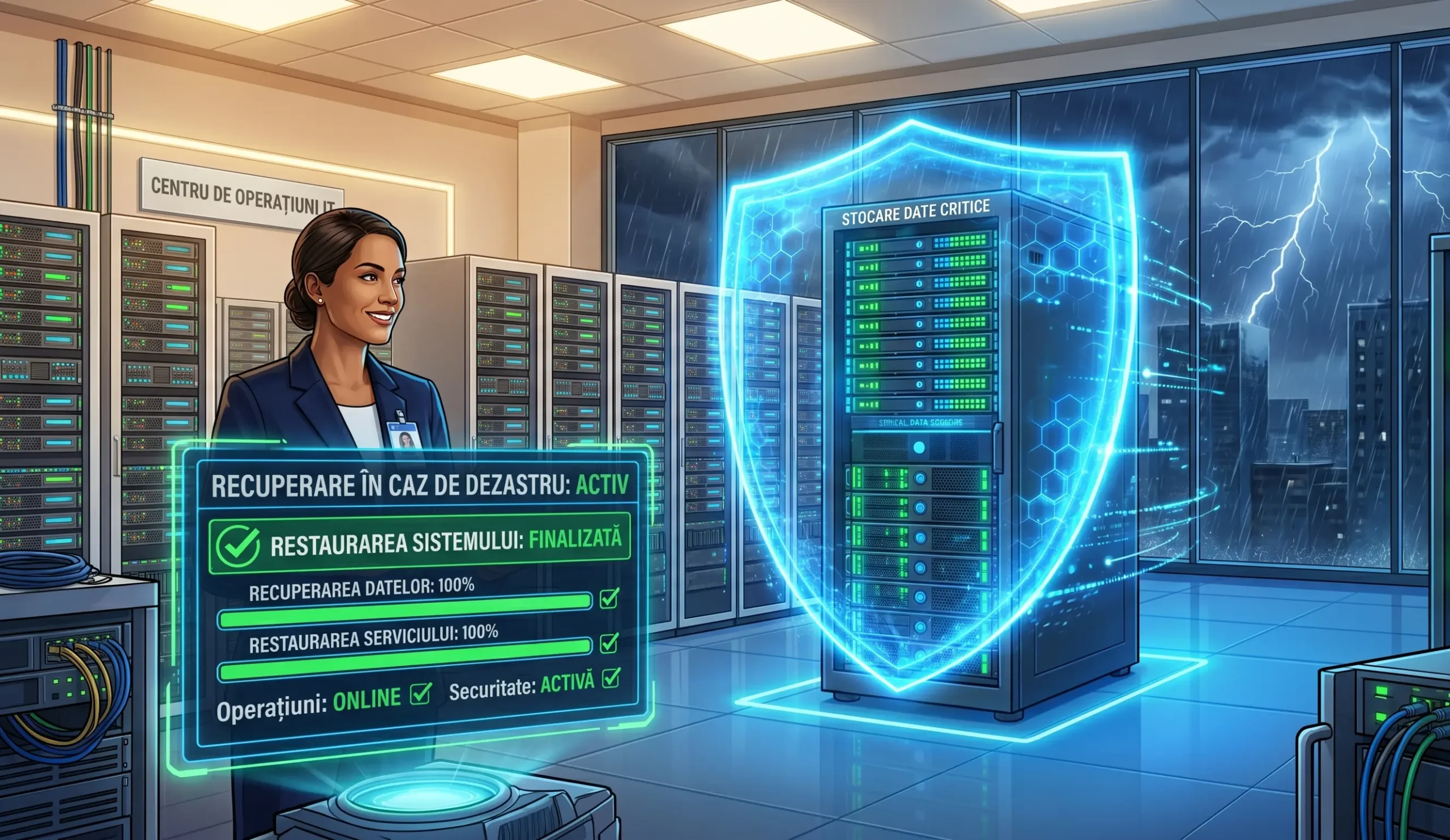
In 2026, data is a company's most valuable asset. An unforeseen incident can completely block daily operations. At Altanet Craiova we recommend implementing a clear emergency plan immediately. This plan is called Disaster Recovery. It ensures business continuity in any critical situation. Whether we are talking about cyberattacks or hardware failures, preparation is vital. Many small businesses ignore these major risks. They risk bankruptcy after a single serious technical error. Prevention and planning are the only sure path to survival.
A continuity plan dictates exactly what must be done during a crisis. Every employee gets a clear role in the recovery process. There is no time for panic or hasty decisions. Business platforms must come back online as quickly as possible. Access to essential documents must be restored within a few hours. This level of organisation separates strong companies from vulnerable ones.
1. The difference between a simple backup and a recovery plan
Many companies confuse saving data with recovering after a disaster. A backup simply copies files to a hard disk. Disaster Recovery is the complete strategy for restoring the entire infrastructure. The experts at Veeam stress the importance of restoring operating systems and networks. Without a clear plan, saved files are completely useless. You can't run accounting software with just some isolated archives.
In 2026, recovery time is the essential metric in IT. In the industry it is known as RTO (Recovery Time Objective). The goal is for the whole company to become functional again quickly. Modern solutions use cloud platforms to restart virtual servers. This technology allows work to resume from any location. People can work from home until the main office is repaired.
| Technical feature | Standard backup | Disaster Recovery (DR) |
|---|---|---|
| Main purpose | Saving individual files | Restoring the entire working environment |
| Recovery time (RTO) | Days or even weeks | From a few minutes to a few hours |
| Complexity | Low (simple data copying) | High (exact procedures and workflows) |
2. Testing the plan and the importance of simulation
A plan written on paper is worth nothing if it is not tested. Emergency procedures should be simulated at least twice a year. During these tests you discover the applications that do not start correctly. You check whether the backup passwords are still valid. Large companies, such as Microsoft, frequently organise cyber disaster simulation days. Staff training reduces panic in the face of a real ransomware attack.
The infrastructure must be flexible and well documented. A new IT employee must understand the procedure within the first few minutes. Clear documentation eliminates delays when the team is under maximum pressure. Automated solutions take over much of the heavy restoration work. In 2026, human intervention is minimal, but oversight is strict. The success of the operation depends on a plan designed by real professionals.
Conclusion: preparation protects a lifetime of work
Disaster Recovery is no longer a concept meant only for large banking corporations. Every SME depends on technology and must actively protect it. Losing customer data brings huge fines and destroys trust earned over years. A continuity plan is a mandatory insurance policy for the digital world. Investing in a backup strategy gives you complete peace of mind every night. Smart businesses don't wait for the storm, they build solid shelters ahead of time.
This article is part of the Altanet series on corporate efficiency. To understand the big picture, see the complete IT management guide for companies in 2026. Next article: UPS systems and energy management: saving servers and data during power outages.