
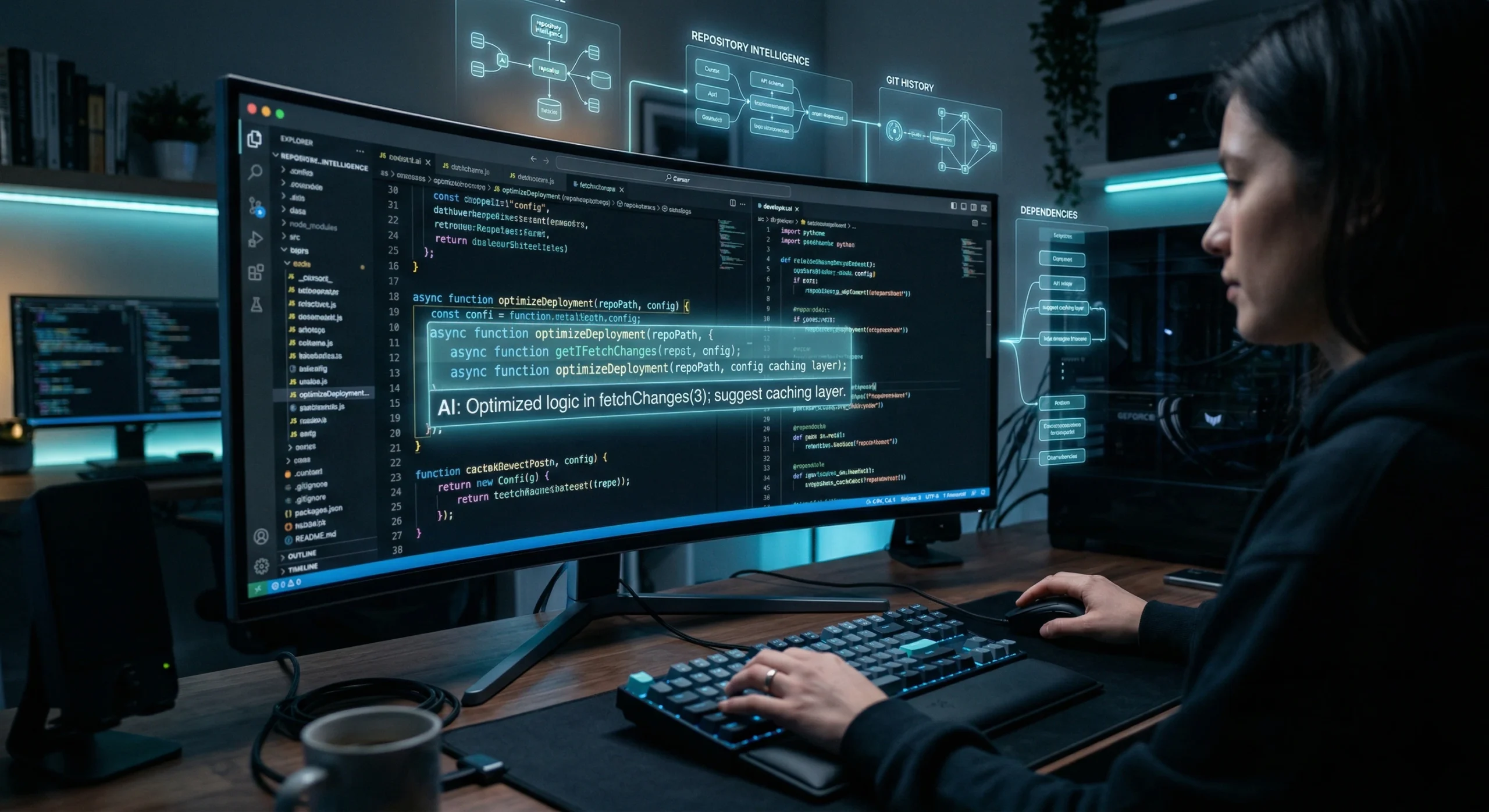
If there is one field where AI has produced a visible, concrete and measurable change over the past two years, it is programming. We are not talking about a modest helper that occasionally suggests a line of code. We are talking about a profound transformation in the way software is written, tested and delivered. At Altanet Craiova we believe that anyone who works with technology – not just programmers – should understand this change.
The numbers that show the scale of the change
GitHub – the world's largest code platform, used by tens of millions of programmers – has published data showing exactly how much activity has changed over the past year:
- 43 million pull requests per month – a 23% increase over the previous year. A pull request is, in short, a proposed change to a program, submitted to colleagues for review.
- 1 billion code contributions per year – a 25% increase over 2024.
- GitHub introduced "repository intelligence" – a feature that lets AI understand not only the code in a single file, but the entire history and structure of a software project.
Mario Rodriguez, an executive at GitHub, summarises the direction well: "AI will understand not just the code, but the relationships and history behind it."
What tools do programmers use in 2026?
The market for AI programming tools has exploded. Here are the most widely used in 2026:
- GitHub Copilot: the AI assistant built directly into the code editor, which suggests lines or entire blocks of a program in real time as the programmer types.
- OpenAI Codex: a complete orchestration system for coding agents – it doesn't just suggest code, it can take a task described in text and solve it autonomously, step by step.
- Cursor: a code editor built from scratch around AI, valued at 9 billion dollars in 2025. It has become the preferred tool of many independent programmers.
- Qwen3-Coder-Next (Alibaba): the Chinese open-source model specialised in writing code, competitive with the best commercial options.
How much productivity has changed
The chart below shows the evolution of the main activity indicators on GitHub, driven by AI tools:
Growth over 2024
Share of total activity
What now takes hours used to take weeks
The biggest impact is not seen in statistics, but in programmers' day-to-day experience. Tasks that used to take whole days – writing automated tests, documenting code, migrating from one technology to another – are now done in hours or even minutes with the help of AI.
A concrete example: a programmer who had to integrate a new service into an existing application used to spend days reading documentation, writing glue code and debugging errors. In 2026, they describe what they need in natural language, and the AI agent generates the code, tests it and flags any problems – all within a few hours.
But the programmer's role is not disappearing – it is transforming
A natural question: if AI writes code, are programmers still needed? The answer is yes – but their role is changing. The programmer of 2026 spends less time writing lines of code and more time:
- Defining problems – clearly explaining what a system should do, not how to do it.
- Checking and validating – AI-generated code must be understood, tested and approved by a human.
- Orchestrating agents – coordinating several AI agents working in parallel on different parts of a project.
What comes next?
Estimates show that by 2027, 80% of production code will be generated or reviewed with the help of AI. Programmers will increasingly become architects and supervisors of systems, not line-by-line code writers.
If your company develops software or works with programming teams and you want to understand how AI tools can speed up delivery and reduce costs, the Altanet Craiova team can help you with a concrete assessment. Visit our contact page and let's talk.
This article is part of the Altanet series on AI trends in 2026. Next article: AI as a Workforce: When the Digital Agent Becomes Employee of the Month. See also the complete guide to the series.