
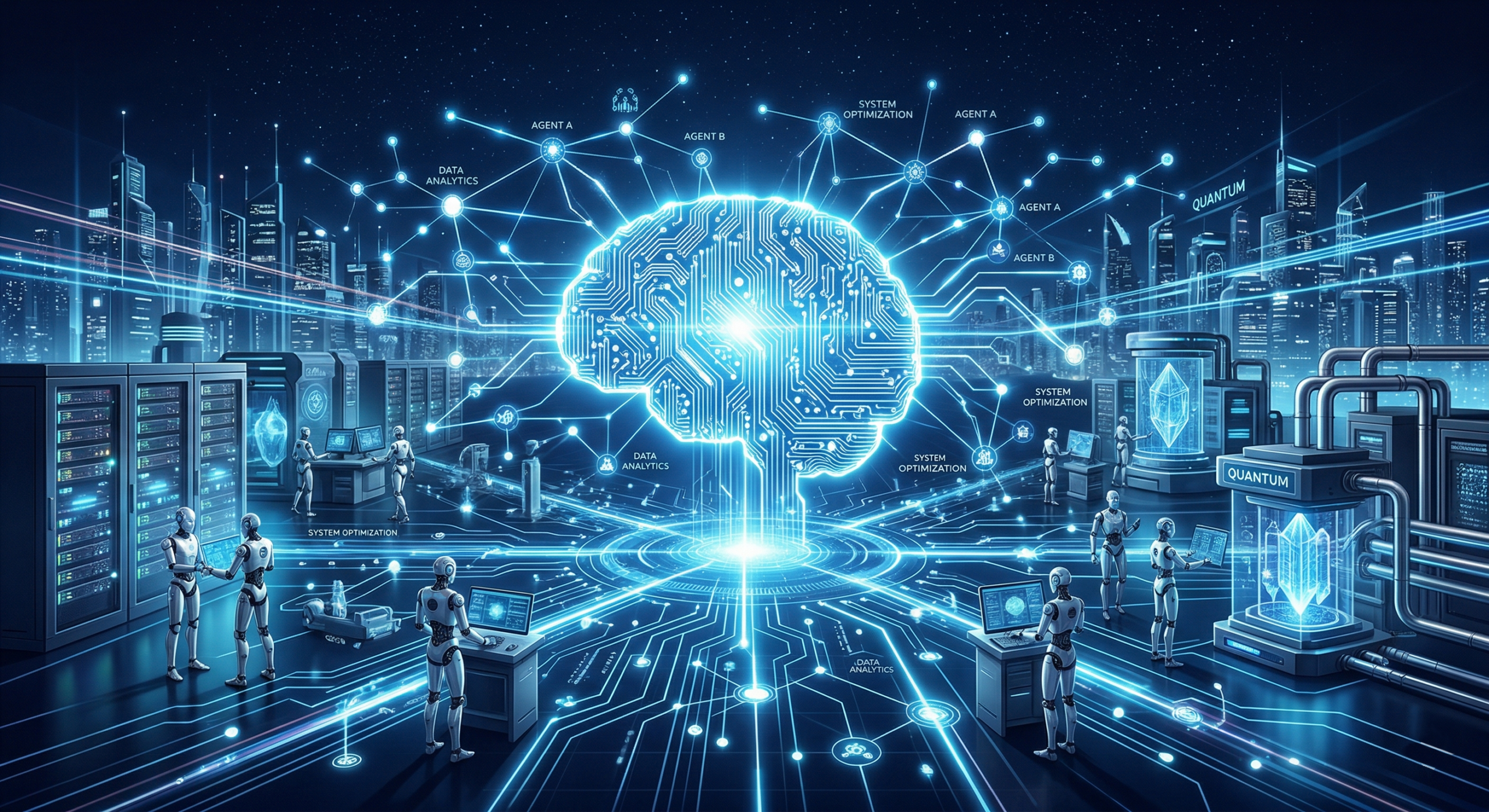
2026 is the year artificial intelligence stopped being a conference topic and became business infrastructure. We are no longer talking about bigger models, but about better systems – agents that work autonomously, models that run on a phone, robots in factories and quantum computers that go beyond classical limits.
At Altanet Craiova we have followed all these changes closely and compiled a complete guide to the 20 trends that define AI right now. Don't be overwhelmed! Read the summary below to understand the complete "map". We will go into each topic in separate articles, but here is everything you need to know.
1. AI agents and top models
AI has moved from a "tool that answers" to a "colleague that acts". Here are the most important changes in this direction:
- Agentic AI: Autonomous AI agents no longer wait for commands – they plan, execute and collaborate with each other. 79% of companies have already deployed such agents. More details in the article: Autonomous AI agents: when artificial intelligence becomes your digital colleague
- The frontier model war: GPT-5, Claude Opus 4.6 and DeepSeek V4 overtake one another weekly. Performance goes up, prices fall dramatically – up to 50x cheaper than a year ago. More details in the article: GPT-5 vs Claude vs DeepSeek: who wins the AI model war in 2026
- Open Source AI: Open-weight models (DeepSeek, Llama, Qwen) have become competitive with commercial ones on almost every test. More details in the article: Open Source AI: why free models have reached the level of subscription ones
- Reasoning models: The new generation of AI "thinks" before answering – it goes through intermediate steps and makes far fewer mistakes on complex problems. More details in the article: Reasoning models: how AI learned to think before it speaks
- Multimodal AI: Every major model now processes text, images, audio and video simultaneously. Multimodality is no longer an extra feature, but the minimum standard. More details in the article: Multimodal AI in 2026: when the robot sees, hears and understands the world just like you
2. AI in the physical world
Artificial intelligence has left the screens and entered factories, hospitals and laboratories:
- Humanoid robotics: The Atlas robot from Boston Dynamics has begun testing in a Hyundai factory. AI robots are becoming standard equipment in logistics and manufacturing. More details in the article: Physical AI and Robotics: when humanoid robots start their first factory job
- AI in healthcare: From symptom triage to dementia detection with 97% accuracy – medical AI has gone from experiment to a product used by millions of patients. More details in the article: AI in Healthcare: how an algorithm detects disease earlier than the doctor
- Scientific AI: GPT-5 has compressed weeks of lab work into hours. AI designs experiments, generates hypotheses and collaborates with researchers like an expert assistant. More details in the article: AI in Science: the lab assistant that never sleeps and never makes calculation errors
- Quantum computing meets AI: IBM has announced that 2026 will be the first year in which a quantum computer solves a problem better than any classical method. More details in the article: Quantum AI: when the quantum computer surpasses classical limits for the first time
3. AI at work and in software
The way we work has changed more in the last year than in the last decade:
- AI in software development: On GitHub, 43 million pull requests per month have appeared (+23%). What used to take weeks is now measured in hours. More details in the article: AI and Programming: how artificial intelligence has transformed every developer's work
- AI as a workforce: Siemens has reached 90% automatic processing in industrial workflows with AI agents, saving 5 million EUR a year. AI no longer assists – it participates. More details in the article: AI as a Workforce: when the digital agent becomes employee of the month
- Personalised and on-device AI: Compact models run directly on a phone or laptop, without internet, with zero latency and completely private data. More details in the article: AI on your device: why the next AI assistant will no longer need the internet
- Photorealistic video generation: Seedance 2.0 and Google Veo 3.1 have turned AI video from a demo into a real production tool for marketing and education. More details in the article: AI Video in 2026: from idea to marketing clip in a few minutes
- Democratising AI agents: No-code platforms now let any employee, not just programmers, create complex AI workflows. More details in the article: No-code AI agents: how anyone builds their own business robot
4. Infrastructure, security and geopolitics
Behind the visible progress, important battles are being fought over control, safety and regulation:
- AI infrastructure: Demand for computing power has outstripped supply. NVIDIA, AMD and IBM launch new chips every quarter. 75% of enterprise AI will run on hybrid infrastructures by 2028. More details in the article: AI infrastructure: why the world is buying chips as if they would run out tomorrow
- AI security: 87% of leaders consider AI vulnerabilities the number one growing risk. Prompt injection attacks and unauthorised model distillation are new, unprecedented threats. More details in the article: AI security: the new types of attacks that no classic antivirus protects you from
- AI geopolitics: The US and China are building two distinct AI ecosystems, with different standards and models. The gap between them has shrunk from months to weeks. More details in the article: AI geopolitics: what the technology war between the US and China looks like
- AI regulation: The EU AI Act is being implemented. California has passed the first frontier AI law. The first major lawsuit against a chatbot maker is expected in November 2026. More details in the article: AI regulation in 2026: the laws that are starting to keep up with technology
- Ethical AI and governance: 86% of companies reported at least one AI incident in the last 12 months. Transparency and accountability are becoming business requirements, not just statements of intent. More details in the article: AI ethics in 2026: why big companies are now hiring artificial intelligence governance heads
- The AI bubble – risk or opportunity? VC investment in agentic AI has grown from 1.3 billion USD (2023) to ~7 billion (2025). Valuations are dizzying, but the average measured ROI is real: 171%. More details in the article: The AI bubble: are we repeating the dot-com mistake or is the enthusiasm truly deserved this time?
Conclusion: why does all this matter to you?
The list seems long, but the central message is simple: AI is no longer optional. It is already the infrastructure on which competitive businesses are built in 2026.
- If you are an entrepreneur or manager: Ask yourself which repetitive processes in your company can be automated with an AI agent. The average reported ROI (return on investment) is 171% – it is not hype, these are figures from real production.
- If you are an employee: Get familiar with the AI tools in your field. It won't be AI that takes your job – it will be the colleague who knows how to work with AI.
- If you are curious: Follow our complete series. Each article explains a trend in simple terms, with real examples and no needless jargon.
The Altanet Craiova team follows these developments for you and translates them into useful information for your business. Have questions about how you can integrate AI into your activity? Visit our contact page and let's talk.
This material opens the Altanet series on artificial intelligence in 2026. Each topic above will be detailed in a separate article, with data, real examples and practical recommendations.