
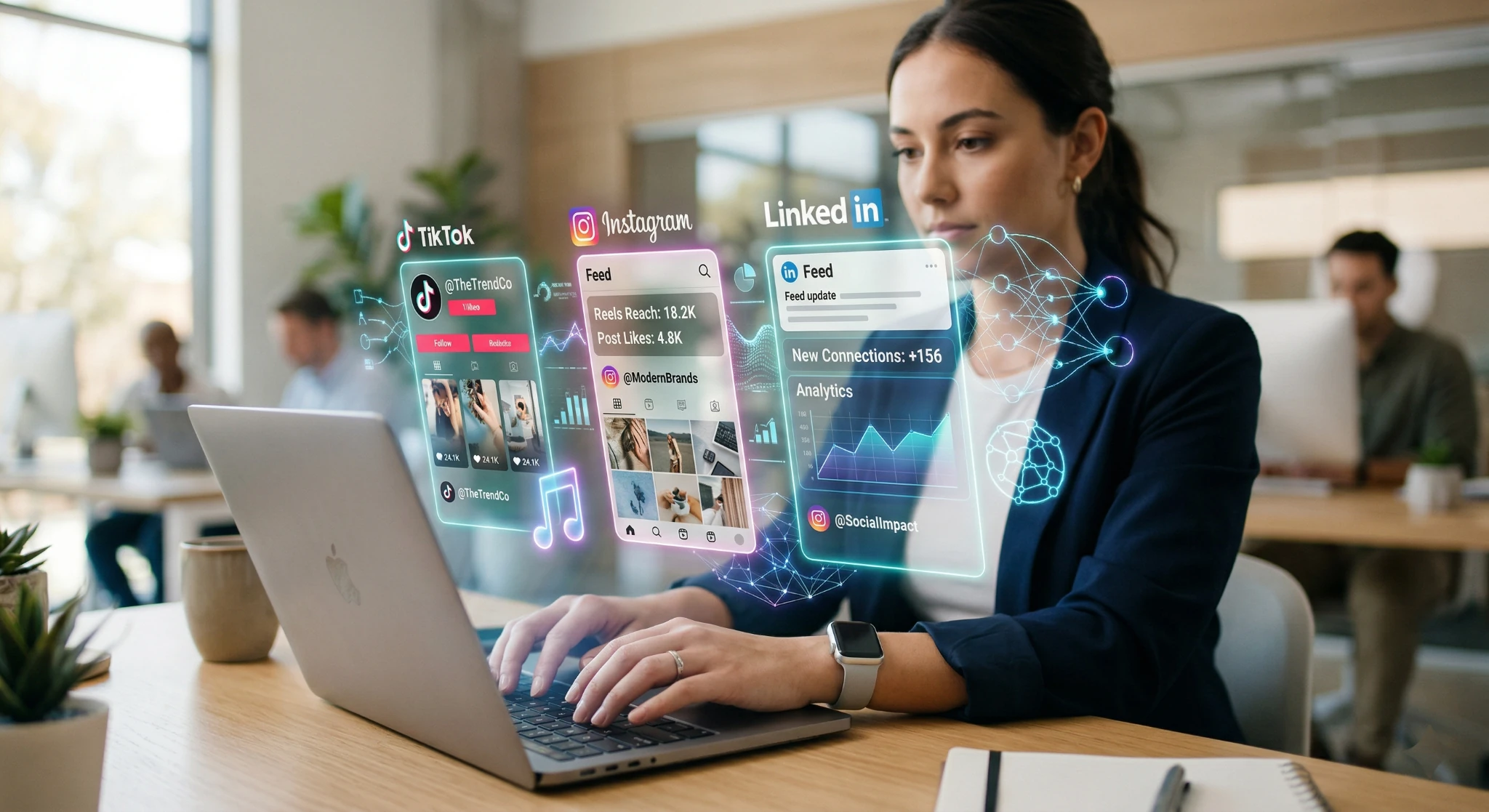
In 2026, almost every social media platform has some kind of AI (artificial intelligence) built in. Instagram suggests automatic captions for you. TikTok generates complete videos from a text. LinkedIn recommends what to post. But how much of your social media work can truly be taken over by AI, and where does the human presence remain essential? At Altanet Craiova we believe this is one of the most important questions for any business active online in 2026.
What can AI do for your social media presence?
Here is what already works well in 2026:
- Generates captions: AI tools can write a caption for a post in a few seconds, based on a short description of the product or topic. Not always perfect, but a good starting point that you can adjust quickly.
- Predicts content performance: platforms such as Metricool, Hootsuite and Sprout Social use AI to estimate how well a post will perform before you publish it – based on your account's history and platform trends.
- Recommends the best time to post: AI analyses when your followers are active and suggests the hour and day with the best chances of visibility.
- Suggests relevant hashtags: instead of searching manually for suitable hashtags, AI proposes them automatically based on the content of the post.
- Generates videos from text: TikTok Symphony Creative Studio turns a written description into a complete video, with picture, voice and subtitles. Especially useful for brands that don't have a video production team.
- Edits and subtitles video automatically: Instagram and CapCut offer AI tools that add subtitles, cut out silent moments and suggest suitable music.
Where can AI not (yet) replace the human?
The limits are just as important to know as the capabilities:
- Brand tone and voice: AI can imitate a style, but it doesn't know your company's story, your values, your inside jokes or your genuine relationship with your customers. Purely AI-generated content often sounds generic and impersonal.
- Reacting to real context: an unexpected event, a communication crisis, an opportunity that appears out of nowhere – these require human judgement and a quick reaction, not automatically generated text.
- Community relationship: replying to comments, conversations in DMs, empathy toward an unhappy customer – these cannot be fully delegated to AI without the risk of losing the community's trust.
- Original creativity: AI recombines what already exists. A truly new idea, an unusual angle, a format invented from scratch – these still come from the human mind.
How much do companies use AI for social media in 2026?
Mature use
Growing
How do you use AI correctly for social media in 2026?
The answer to the question in the title is: AI is an excellent tool, not a complete strategist. The formula that works in 2026 is:
- AI does the repetitive work: subtitles, hashtags, scheduling posts, resizing images for each platform, translations.
- The human does the creative and relational work: strategic direction, brand voice, replies to the community, original ideas, communication decisions in sensitive situations.
- Always check what AI generates before you publish. Purely AI content without human oversight is increasingly penalised by algorithms and perceived negatively by audiences.
- Transparency helps: platforms are introducing labels for AI-generated content. Audiences appreciate honesty more than perfection.
What comes next?
According to Vvitch Digital, over 50% of social media content will be AI-assisted (produced with the help of AI) by 2027. But purely AI content, without human intervention, will be penalised by algorithms. The winners will be those who know how to use AI to work more efficiently, not to disappear from the creative process.
Want to know how you can integrate AI into your social media process without losing your authentic voice? The Altanet Craiova team can help you with a concrete plan. Visit our contact page and let's talk.
This article is part of the Altanet series on changes in social media and SEO in 2026. Next article: Micro-communities and Dark Social in 2026: Why You Can No Longer Measure the Most Important Conversations. See also the complete guide to the series.