
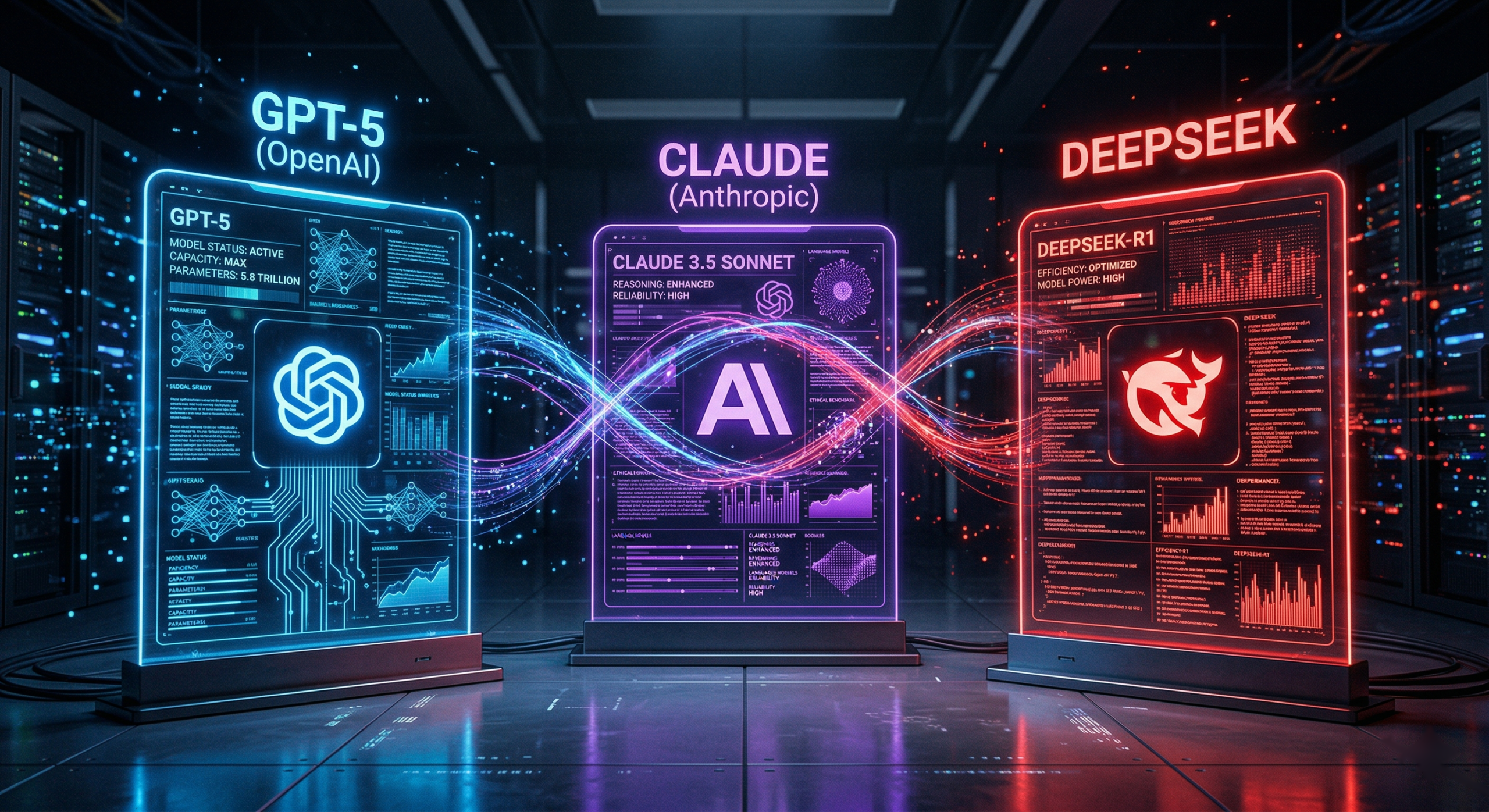
In 2026, the competition between the major AI models has become more intense than ever. We are no longer talking about annual updates – new versions appear every 2-3 weeks, each bringing concrete improvements. At Altanet Craiova we follow this race closely, because choosing the right model can make the difference between a useful tool and an exceptional one for your business.
The Three Big Players of 2026
The frontier model landscape is currently dominated by three main competitors, each with its own strengths:
GPT-5 (OpenAI)
The latest OpenAI model solves complex problems with 50-80% fewer tokens than its predecessor, o3. In practice, that means faster answers and lower costs. One remarkable result: GPT-5 demonstrated a 79x efficiency gain in molecular cloning protocols, compressing weeks of lab work into hours. The model "makes up" false information half as often as its predecessor – from 4.8% to 2.1% of cases.
Claude Opus 4.6 (Anthropic)
The Anthropic model introduces a practical novelty: 4 effort levels (low, medium, high, max), which the user can select depending on the complexity of the task. For simple questions, you use fewer resources. For complex problems, you activate extended reasoning. In addition, context compaction allows longer conversations without losing earlier information.
DeepSeek V4 (China)
The surprise of the year comes from China. DeepSeek V4 was released in March 2026 with 1 trillion parameters (of which 32 billion are active per token), native multimodal support and a context window of 1 million tokens. The price: $0.10-0.30 per million tokens – up to 50x cheaper than GPT-5. It runs on processors made by Huawei and Cambricon, thus avoiding US export restrictions.
How Prices Have Evolved – The Chart That Changes Everything
Perhaps the most important trend of 2026 is not performance but cost. In just 2 years, the price per million tokens for frontier models has dropped dramatically:
GPT (OpenAI)
Claude (Anthropic)
DeepSeek (China)
$5
$0.27
$2
$2
$0.10
The conclusion is clear: in 3 years, the cost has dropped by 300 times for top models. What cost $30 per million tokens in 2023 costs $0.10 today with DeepSeek V4.
Multimodality Has Become Standard
Another important leap: all frontier models in 2026 process text, images, audio and video at the same time. It is no longer a luxury feature – it is the expected minimum. Kimi K2.5 from Moonshot AI goes even further, introducing a "swarm mode" with up to 100 sub-agents working in parallel on the same task.
Which Model Should You Choose for Your Business?
There is no universal answer, but here is a practical guide:
- For complex, critical tasks (legal analysis, research, production code): GPT-5 or Claude Opus 4.6 – maximum performance, higher cost
- For high processing volumes (customer support, document summarisation, data classification): DeepSeek V4 or Gemini 3.1 Pro – excellent performance at minimal cost
- For confidentiality and sensitive data: open-source models run locally (see the article on Open Source AI in this series)
What's Next in the Model War?
The trend is clear: frontier models are becoming a commodity. Differentiation is no longer based on model size, but on orchestration, security and integration into business workflows. Prices will keep falling – estimates point to a further 80% reduction by 2027.
For you as an entrepreneur or manager, the message is simple: access to high-performance AI is no longer a budget problem. It is a strategy problem – do you know what you want to automate and how?
The Altanet Craiova team can help you identify the right model for your needs and integrate it efficiently into your existing processes. Go to our contact page and let's talk.
This article is part of the Altanet series on AI trends in 2026. Next article: Open Source AI: Why Free Models Have Reached the Level of Subscription Ones. See also the complete guide to the series.